
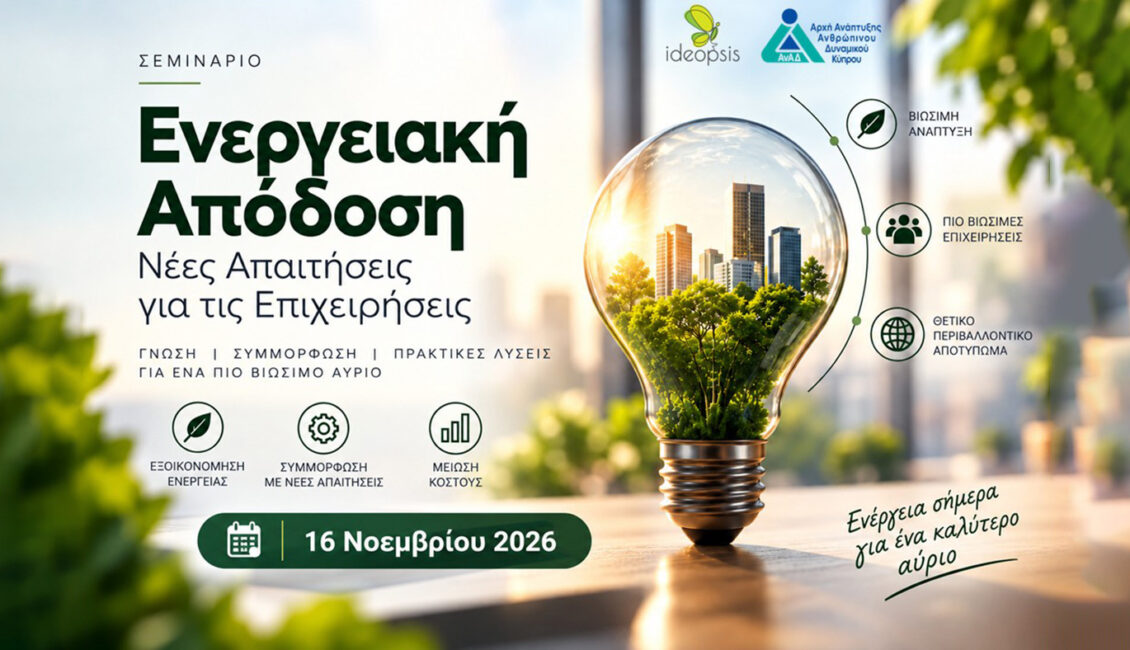
Energy Efficiency: New Requirements for Businesses
Energy efficiency is taking on new significance for businesses. The new European Energy Efficiency Directive (EU) 2023/1791 and its implementation in Cyprus through Law 92(I)/2026 introduce a new framework of obligations, in which the key criterion is now the business’s annual energy consumption rather than its size.
The new requirements highlight the need for more systematic energy monitoring and management, the carrying out of energy audits and for businesses with higher energy consumption, the implementation of certified energy management systems, such as ISO 50001.
The seminar explains in a practical and accessible way what is changing, which businesses are affected, and how they can prepare for the new requirements.
Why take part?
- Find out what’s changing under the new legislation
- Prepare for the new requirements
- Reduce consumption and energy costs
- Learn about ISO 50001 in practice
- Turn compliance into a business advantage
Upon completion of the training, participants will be able to:
- Understand the new requirements of energy efficiency legislation
- Recognise the key obligations relating to energy audits and energy management systems.
- Understand the key principles and requirements of ISO 50001
- Analyse key energy consumption data
- Link energy efficiency to the organisation’s broader sustainability, ESG and competitiveness objectives.
Dates: 16 November 2026, 9:00-17:15
Seminar cost: €300 | AnAD grant €140 | Net cost €160
Ermis HRDA Code: 765018
The seminar is subsidised by Human Resource Development Authority of Cyprus (HRDA).