
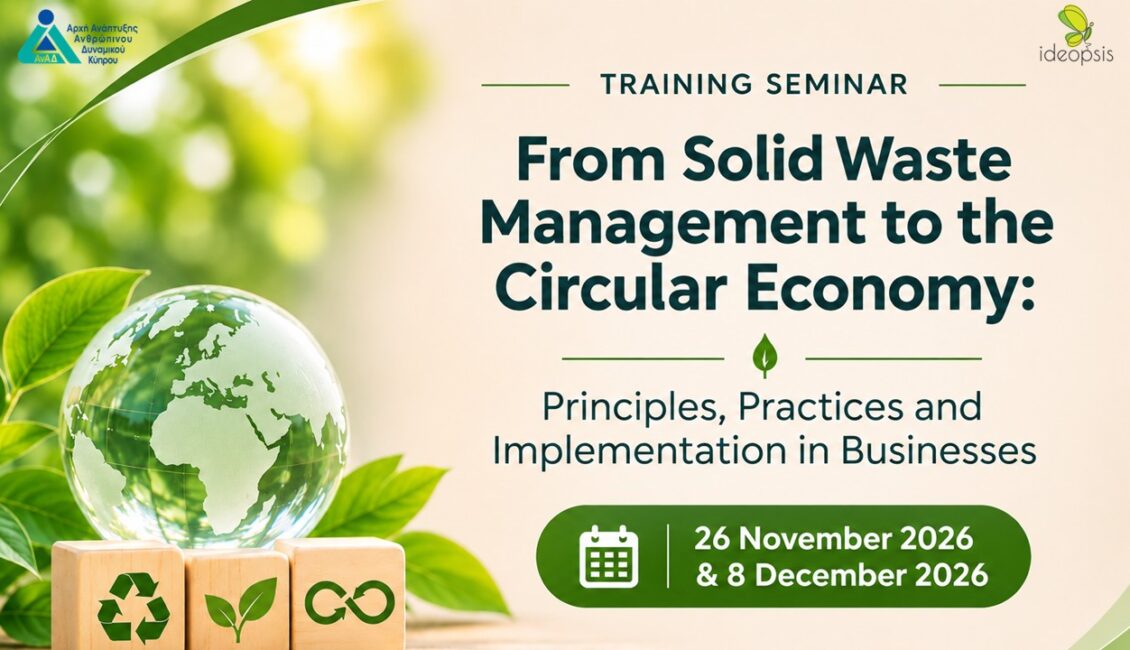
From Solid Waste Management to the Circular Economy: Principles, Practices and Implementation in Businesses
The effective management of solid waste and the transition to a circular economy are now key priorities for modern businesses. Developments in the European and national regulatory frameworks, combined with the objectives of the European Green Deal and the Circular Economy Action Plan, are creating new requirements as well as opportunities for a more efficient use of resources and a reduction in the environmental footprint.
The seminar provides up-to-date, practice-oriented training in solid waste management and the circular economy. Participants will become familiar with the current regulatory framework, the waste hierarchy and tools for prevention, reuse, recycling, resource efficiency and the development of circular business models.
Through real-life examples, exercises and case studies, the programme provides tools for mapping material flows, identifying points of value loss and formulating actionable circularity measures. Participants will be able to prioritise opportunities, set targets and performance indicators, and link environmental improvement to cost reduction, compliance and competitiveness.
Why take part?
- Understand current requirements for solid waste management
- Gain a comprehensive understanding of the waste hierarchy, the regulatory framework and practices relating to prevention, separate collection, reuse, recycling and recovery.
- Integrate the principles of the circular economy into your business
- Learn to identify losses of materials and value, and to implement practices for waste prevention, efficient use of resources, circular procurement and extending the useful life of products and materials.
- Turn circularity into business value
Identify opportunities to reduce costs and risks, develop circular business models, improve environmental performance, and enhance resilience and competitiveness.
Upon completion of the training, participants will be able to:
- Identify the main waste streams and select appropriate solutions in accordance with the waste hierarchy.
- Interpret the key requirements of the European and national regulatory frameworks and the organisation’s obligations.
- Organise basic procedures for waste prevention, separate collection, safe temporary storage, documentation and handover of waste to authorised waste managers.
- Identify opportunities for circularity through material flow analysis, life-cycle thinking and value retention strategies.
- Draw up a basic action plan setting out priorities, responsibilities, a timetable, targets and key performance indicators (KPIs).
Dates: 26 November 2026, 9:00 – 16:00 | 8 December 2026, 9:00 – 13:15
Seminar cost: €320 | AnAD grant €200 | Net cost €120
Ermis HRDA Code: 747314
The seminar is subsidised by Human Resource Development Authority of Cyprus (HRDA).
