
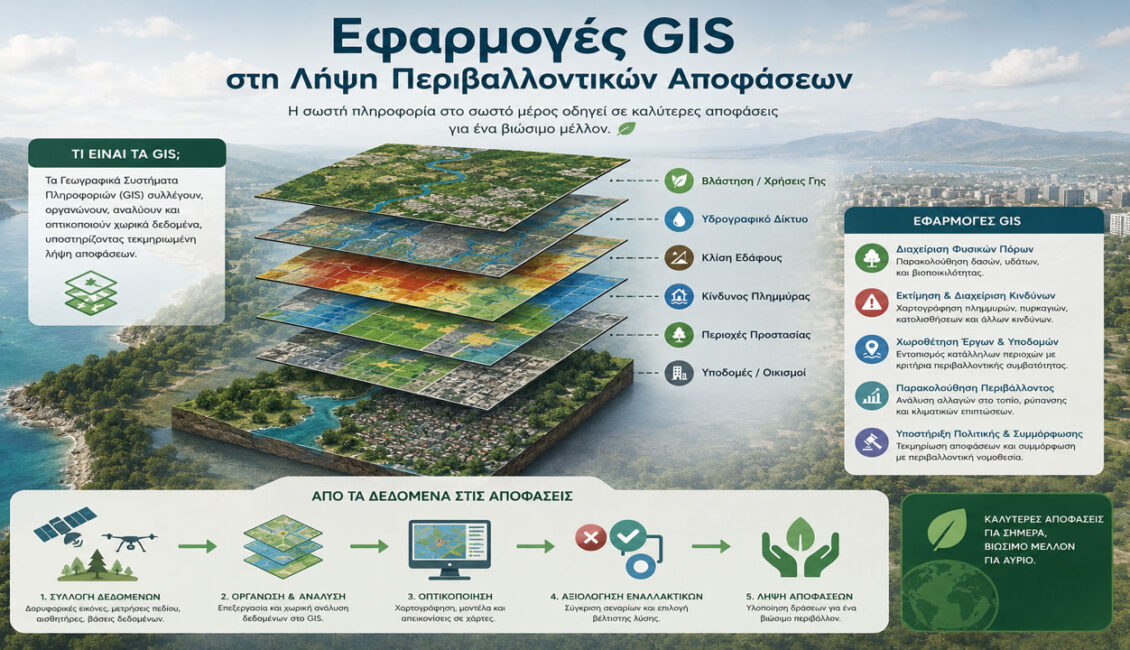
GIS Applications in Environmental Decision-Making

    Dates: 29-30 June 2026
    HRDA Code: 724032

    GIS Applications in Environmental Decision-Making

    A Must-Attend Training on GIS Applications

    The green and digital transition of the economy, combined with the growing requirements of European policies and funding programs make skills in the management and utilization of geospatial data particularly important for today’s professionals.

    Geographic Information Systems (GIS) are now one of the most powerful tools for analysis and decision-making support in sectors such as the environment, energy, spatial planning, sustainable development, civil protection, and climate resilience. Acquiring practical knowledge and skills in the use of GIS significantly enhances participants’ career prospects and their ability to meet the modern demands of the job market.

    This 14-hour training programme provides practical, application-oriented training in the use of GIS for environmental analysis, mapping, environmental impact assessment and evidence-based decision-making.

    What the Training Covers

    • Fundamentals of Geographic Information Systems (GIS)
    • Geospatial Data Sources, Management and Visualisation
    • Spatial Analysis for Environmental Decision-Making
    • Use of GIS in Sustainable Development and Environmental Planning
    • Working with Real-World Data Sources
    • Practical Applications using case studies like Renewable Energy, Natural Resource Management and Climate Resilience

    Who Should Attend

    The programme is aimed at professionals and executives working in fields such as the environment, energy, spatial planning and technical studies, as well as individuals involved in projects, studies or decision-making processes with environmental or spatial dimensions.

    • Engineers, environmental professionals, urban planners, architects and other public or private sector professionals involved in projects, studies or policies related to the environment, energy and sustainable development.
    • Professionals from consulting, technical, research, planning or design organisations who wish to strengthen their ability to use GIS for data analysis, environmental assessment and decision-making.

    Prior experience with GIS is not required. However, participants should have basic computer skills and an interest in environmental analysis, spatial data and sustainable planning.

    Ermis HRDA Code 724032
    Dates: 29-30 June 2026
    Seminar cost €380 | HRDA subsidy €280 | Net cost €100
    The seminar is approved by Human Resource Development Authority of Cyprus (HRDA)

    Event Details
    Software Developer | GIS & Environmental Applications
    LemonHub
    Introduction to GIS and Geospatial Data
    • Duration: 2 Hours
      Introduction to GIS and Geospatial Data

      • Basic principles of Geographic Information Systems (GIS) and their role in environmental analysis and decision-making.
      • Main categories of geospatial data, including vector, raster and tabular data, and how they are used in GIS workflows.
      • National, European and international geospatial data sources and platforms relevant to Cyprus, environmental planning and spatial decision-making.
      • Key concepts such as spatial accuracy, resolution, scale, coordinate reference systems and and data suitability for environmental analysis.
      • Importance of GIS in modelling environmental phenomena, supporting technical studies and enabling evidence-based decision-making.

    Tools and Data Sources
    • Duration: 3 Hours
      Tools and Data Sources

      • Use of QGIS as a practical tool for organising, viewing, managing and analysing geospatial data.
      • Import, organisation and integration of data from different sources, including vector data, raster data, tabular data, web services and open geospatial data sources.
      • Georeferencing of scanned maps or other non-spatial material for use in a GIS environment.
      • Basic principles of metadata, data quality, reliability, scale, update status and limitations of use.
      • Brief introduction to drone-derived geospatial data as a supporting source of high-resolution information for environmental mapping and documentation.
      • The drone-related content is presented as a GIS data workflow, not as drone pilot training or flight certification.

    Spatial Analysis and Environmental Applications
    • Duration: 2 Hours
      Spatial Analysis and Environmental Applications

      • Key spatial analysis concepts and tools used in environmental applications.
      • Use of spatial relationships, buffer zones, overlay analysis and spatial queries to support environmental analysis.
      • Introduction to multi-criteria decision analysis and suitability analysis for environmental and spatial planning scenarios.
      • Indicative applications such as renewable energy or infrastructure siting, assessment of environmental pressures, risk mapping and comparison of alternative planning scenarios.
      • Emphasis on selecting appropriate criteria, documenting assumptions and interpreting results responsibly.

    GIS Applications in Environmental Decision-Making
    • Duration: 2 Hours
      GIS Applications in Environmental Decision-Making

      • Practical examples of how GIS supports environmental decision-making in professional contexts.
      • Applications related to risk identification, land use, project siting, vulnerability analysis, pollution monitoring, natural resource management and environmental assessment.
      • Use of GIS outputs to support Environmental Impact Assessments, technical reports, planning processes and communication with stakeholders.
      • Use of spatial evidence to compare alternatives, identify sensitive areas and highlight potential land-use or environmental conflicts.
      • Emphasis on transparent, evidence-based and well-documented decision-making.

    Visualisation and Presentation of Results
    • Duration: 2 Hours
      Visualisation and Presentation of Results

      • Creation of thematic maps, professional map layouts, concise reports and decision-support outputs.
      • Selection of appropriate symbols, colour schemes, classification methods, legends, titles, scale information and data-source references.
      • Use of QGIS layout tools to prepare clear cartographic outputs for technical studies, reports and presentations.
      • Emphasis on producing maps and outputs that answer a specific environmental question clearly and responsibly.

    Practical Application Workshop Using Cypriot Data
    • Duration: 3 Hours
      Practical Application Workshop Using Cypriot Data

      • Practical application through an integrated Cyprus-based environmental case study.
      - Indicative case studies may include preliminary site selection for a renewable energy project, flood-risk analysis, mapping of environmental pressures or assessment of vulnerability to climate-related risks.
      - Application of the main stages of a GIS-based decision-support workflow: defining the environmental question, selecting and reviewing data, preparing layers, applying spatial analysis, visualising results and preparing a short technical explanation.
      - Use of realistic geospatial data and environmental criteria relevant to Cyprus.
      - Production of a thematic map and a brief decision-support note simulating a practical environmental study deliverable.

      Event Details